Whole roofline guide
Replacing the whole roofline in Cwmbran: a planning guide
What renewing fascias, soffits, gutters and downpipes together involves on a Cwmbran house, the choices along the way, and what to agree before anyone puts up a ladder or a tower.
What “the roofline” takes in
Roofline is the trade’s shorthand for the strip of materials that finishes the bottom edge of a pitched roof. On a typical Cwmbran semi or terrace it means the fascia boards across the front and back, the soffits tucked underneath, the gutters along the fascias and the downpipes down the walls. On a gable-ended house it also includes the boards that follow the slope of the roof at each end.
The Welsh Government’s building regulations guidance describes the two boards in its own terms. Its wording for each is worth reading, because it explains why the boards and the gutter are so closely tied:
These are boards attached to the end of the rafters/truss at the eaves, where the guttering is attached for the roof rainwater drainage. These are also placed at the ends of gable roofs to cover the rafters/truss.
Welsh Government: Building regulations: fascias
These are placed on the underside of the eaves where the roof overhangs the walls. This is where the ventilation holes are generally provided.
Welsh Government: Building regulations: fascias
The first passage is about fascias, the second about soffits. Put simply: the gutter hangs on the fascia, and the roof space breathes through the soffit. Neither can be treated as a cosmetic extra.
Why renewing it in one visit usually pays
Fascias, soffits and gutters on most houses went up at the same time and have weathered side by side ever since. When one is clearly failing, the others are rarely far behind. Three practical reasons favour doing the lot together.
- Access is shared. Two-storey eaves need a tower or scaffolding, and that cost comes round again every time someone has to reach the roof edge.
- The gutter depends on the board. Brackets fixed into soft timber pull out over time, however good the new gutter is.
- Ventilation is set at the soffit. Changing the boards is the moment to make sure the roof space still gets enough air.
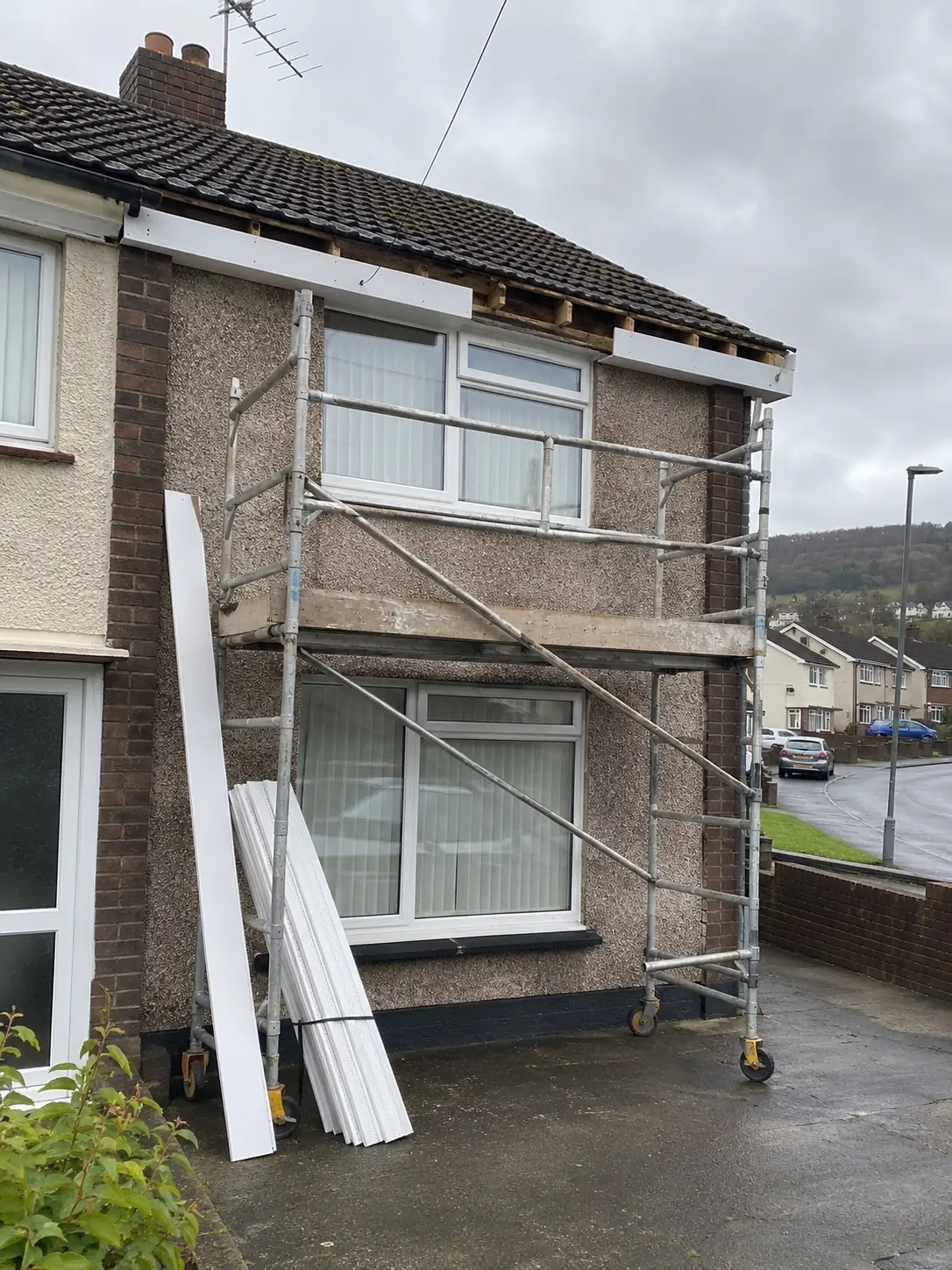
None of that means a sound board must come down. If an installer finds the timber in good order, ask what the options are, and weigh them against the cost of putting up access twice.
The job from start to finish
- Survey. The installer looks along every elevation, counts corners, outlets and downpipes, checks how the soffits are vented and notes how a tower or scaffold could stand.
- Access. Scaffolding or a tower goes up. On a terrace, it can help to tell the neighbours beforehand.
- Strip. The old gutters and downpipes come off first, then the boards are taken down, or left in place if the plan is to cover them.
- Look behind. With the old boards off, the rafter ends are on show. Rot, old nests and missing felt at the eaves show up here and nowhere else.
- New boards. Soffits go in with ventilation at least as good as before, then the fascias, then any trims at corners and gable ends.
- Rainwater. Gutters are set to fall towards the outlets, joined and bracketed, and downpipes are connected to the drains.
- Clear away. The old material is taken off site and the access comes down. Ask to walk round and look at each corner before it does.
Replacing the boards or covering them
There are two ways to put new uPVC on an old roof edge. A full replacement takes the old timber down and fixes new boards to the rafter ends. Capping, sometimes called overboarding, leaves the old timber where it is and clads it with a thin uPVC skin.
Capping costs less and makes less mess. Its weakness is that whatever state the timber underneath is in stays hidden. Over sound, dry wood that can be fine; over wood that is already soft, the decay carries on out of sight. If capping is offered, ask how the timber was checked and whether you can see it first.
Options side by side
A general comparison, not a judgement on any one house. The last column compares what the work itself tends to cost.
| Option | What happens | Suits | Watch for | Relative cost |
|---|---|---|---|---|
| Full replacement | Old boards and gutters removed; new soffits, fascias, gutters and downpipes fitted | Tired or rotten timber, or several faults at once | Ventilation kept or improved; rafter ends repaired if needed | Highest |
| Capping over timber | uPVC skin fixed over the existing boards; often new gutters too | Old boards that are dry, straight and sound | Hidden rot; extra thickness at the edge | Middle |
| New gutters only | Gutters and downpipes replaced on the existing boards | Sound fascias with leaking or sagging gutters | Fixings into weak wood | Lower |
| Repair and repaint | Damaged sections cut out, filled and painted; joints resealed | Small, local damage on otherwise good timber | Repainting every few years | Lowest at first |
Cwmbran houses and Cwmbran weather
Cwmbran became a new town in 1949, built around older villages, among them Old Cwmbran, Pontnewydd, Upper Cwmbran, Llantarnam and Croesyceiliog. Old Cwmbran itself grew up around tinplate works. That mix means one part of town has terraces from the industrial villages and the next has houses built for the new town. Each kind has its own roof edge, so an installer who knows the area should ask about the house rather than assume.
The town also sits under hills that climb to more than 1,000 feet on its western and northern sides. Rain is the everyday test for any gutter here. At Usk, the closest Met Office climate station, the 1991–2020 average was 1,110.7 mm a year, with January alone averaging 127.35 mm over about 14.6 days of rain. Those are figures for Usk, not for Cwmbran itself, but they give a fair picture of what a gutter in the valley has to carry each winter.
If your house is in the Llantarnam or Upper Cwmbran conservation area, or is a listed building, read the Torfaen rules page before booking anything.
Before agreeing a price, ask
- Will you take the old boards down, or cover them? If covering, how have you checked the timber?
- How will the new soffits ventilate the roof space, compared with what is there now?
- Is scaffolding or a tower included, and is it shown as its own line?
- Which parts of the house are in the quote: front, back, gable ends, porch, bay, garage?
- Which gutter profile and colour are you suggesting, and can I see a sample?
- How many downpipes will there be, and where will each one discharge?
- What happens if you find rotten rafter ends?
- Is taking away the old boards and gutters in the price?
- Which guarantees apply: one for the materials, and one for the workmanship?
Asking every installer the same things lets you set their prices side by side. For what tends to push a total up or down, see the cost guide.
More short answers
How long does a whole roofline take?
That depends on the size of the house, the access and what turns up behind the old boards. Ask each installer for their estimate, and whether the scaffold will stay up over a weekend.
Does someone have to stay in?
Usually not all the time, as the work is outside. Someone should be around at the start to agree the plan and at the end to look it over.
Can the colour change from white?
Yes. Boards and gutters come in several colours and finishes; the fascias and soffits page has more on choosing.
Why the name Llantarnam?
Llantarnam is one of the older places within Cwmbran. The guide covers the whole town, not only that district.
Sources: Welsh Government: Building regulations: fascias; Wikipedia: Cwmbran (secondary source); Met Office: Usk climate averages, 1991–2020. All viewed 3 November 2026.
Planning the whole roofline?
Say which sides of the house need work and what you have spotted, and ask for a price.