Guttering and downpipes
Guttering and downpipes in Cwmbran
A gutter has one task: catch the rain coming off the roof and send it down to the drain without spilling on the walls. Here is what decides whether new guttering manages that for years.
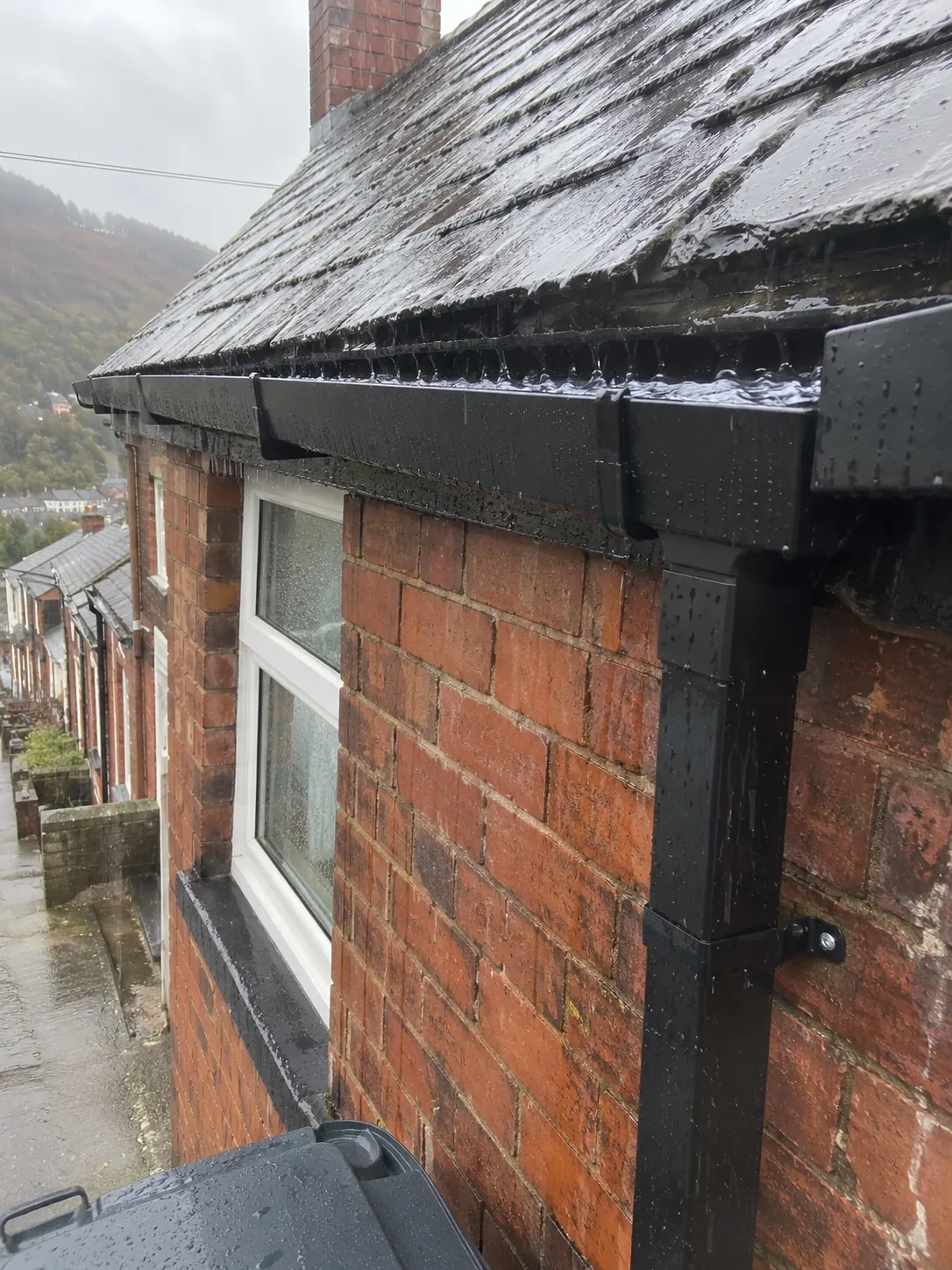
What makes a gutter run work
- Fall. A gentle, even slope towards each outlet, so water never sits in a dip.
- Brackets. Fixed close enough together, and into sound timber, so the run cannot sag under snow or a full load of rain.
- Joints. Unions and corners seated properly, with seals that stay tight as the plastic warms and cools.
- Outlets. Enough of them, in the right places, for the size of the roof feeding them.
Most leaks come from one of those four things rather than from the gutter itself wearing out.
Profiles and materials
| Choice | Shape | Good for | Bear in mind |
|---|---|---|---|
| Half-round uPVC | Rounded channel | Most houses; looks right on older terraces | Smaller capacity than deeper shapes |
| Square-line uPVC | Flat-sided box | Modern houses and crisp edges | Debris can sit in the square corners |
| Deep-flow uPVC | Wider, deeper channel | Larger or steeper roofs that shed a lot of water | Bulkier look from the street |
| Aluminium | Several profiles, often seamless runs | Long, straight elevations; colour choice | Higher cost than plastic |
| Cast iron | Traditional half-round or ogee | Period and listed houses | Weight, cost and painting |
With Cwmbran’s winter rain in mind, it is reasonable to ask whether a deeper gutter suits your roof, especially where a large slope empties into a short run.
Concrete gutters
Some houses have gutters that are not fixed to a fascia at all. Instead, a channel of concrete is built into the top of the wall and forms part of the eaves. They are often known by the trade name Finlock. When these crack or their joints open, water can get straight into the wall below.
Replacing them is a bigger task than swapping plastic gutters. The concrete units are usually taken out, the top of the wall made good, and a new timber or uPVC eaves built so that ordinary gutters can be fitted. Lining the old channels is sometimes offered as a cheaper route; ask how long that is expected to last and what happens to the wall beneath.
If you are not sure whether your house has them, look at the eaves from the street: concrete gutters look like a chunky ledge along the top of the wall, painted or bare, with no separate wooden or plastic board above. A photo on the quote form settles the question quickly.
Downpipes and where the water goes
Each downpipe should carry its water into an underground drain, a soakaway or a water butt with an overflow. Water simply poured onto a path or a lawn next to the wall can soak into the brickwork and the foundations.
- Count the downpipes now and ask how many the new layout will have.
- If one is moving, ask where it will discharge, and whether a new drain connection is needed.
- On a terrace, the gutter may be shared at the party line. Talk to the neighbours before work starts.
- Ask for leaf guards or outlet strainers if trees overhang the roof.
Overhanging trees in a conservation area need permission before any work on them. The Torfaen rules page has the council’s wording.
Clearing, repairing or replacing
A blocked gutter only needs clearing. A single dripping joint can often be resealed. This guide is about the point beyond that, when the run sags, cracks, spills along its length or is fixed to boards that no longer hold a screw. That is when replacement, often with the boards behind, is worth pricing.
Questions about the guttering
- Which profile and size are you suggesting for my roof, and why?
- How far apart will the brackets be?
- Are the downpipes and fittings included in the same colour?
- Will the old gutters and pipes be taken away?
- If I have concrete gutters, how will the eaves be rebuilt?
Gutters overflowing or sagging?
Mention where water spills and add a photo after rain if you have one.